From March 2026, the Drug Tariff will gain a new reimbursement category: Category H. At first glance, this might sound like yet another technical adjustment tucked away in Part VIIIA. In reality, it has the potential to change how some familiar medicines behave financially for dispensing practices, and my fear is this will not be for the better!
While the change stems from wider NHS medicines margin reforms, it will apply just as much to dispensing doctors as it does to community pharmacies. And for practices that rely on predictable reimbursement from certain medicines, Category H is worth understanding well before it arrives.
Why introduce a new category at all?
Part VIIIA of the Drug Tariff sets the reimbursement prices for generically prescribed medicines. Over the years, different categories have been used to reflect how medicines are supplied and priced in the market.
Category C was originally created for medicines where reimbursement needed to be linked to the price of a specific branded product — usually because that brand was the only realistic supplier at the time. Many dispensing practices will be familiar with Category C items that have behaved in a fairly stable, predictable way for years.
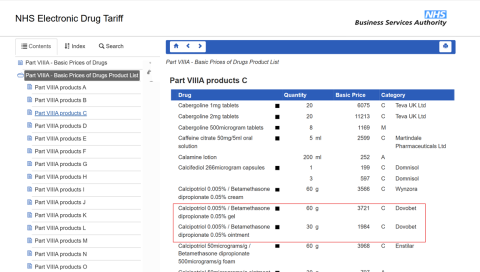
Below is an example of a Cat C generic listing where the Calcipotriol/Betamethasone gel or ointment are reimbursed as the originator brand Dovobet.
The problem, from DHSC’s perspective, is that the market has moved on. Some medicines still listed in Category C are now supplied by multiple manufacturers, even though reimbursement remains tied to one historic reference product. Category H is intended to correct that mismatch.
What exactly is Category H?
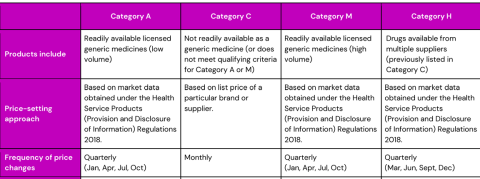
Category H will apply to medicines that are currently in Category C but are now considered multi-supplier products.
From March 2026, these medicines have begun to move into Category H in phases, rather than all at once. The crucial difference is how reimbursement prices will be set. Instead of being based on the price of a single reference product, Category H prices now will be calculated using supplier-reported market data.
In plain terms, this means reimbursement prices are likely to become more closely tied to what suppliers are actually charging across the market — and therefore more likely to change.
What might this mean for dispensing practices?
For many practices, Category C medicines have felt relatively “safe”. Prices have often been steady, and in many cases, reimbursement has comfortably covered purchase costs affording us all a healthy margin if we are savvy purchasers.
Once medicines move into Category H, that stability and opportunity may no longer be guaranteed. Reimbursement prices could go up or down, depending on how historic Category C prices compare with current market pricing. Practices should be cautious about assuming that medicines which have historically delivered consistent margin will continue to do so.
Margins, stock and purchasing: Where the risk lies
Dispensing margin is still the difference between reimbursement and acquisition cost. What Category H changes, is how predictable that difference may be.
If reimbursement prices respond more quickly to market data, practices could see periods where reimbursement lags behind purchase prices, short-term improvements followed by later adjustments, and increased sensitivity to when stock was purchased and at what price.
Holding significant quantities of stock bought under old reimbursement assumptions could expose practices to financial risk if prices fall, which they inevitably will.
Category H items introduced in March.
| Generic Product | Cat C Price | Cat C reference brand | Other brands (list not exhaustive) | brand price (dm+d) | Cat H price |
| Cinchocaine 5mg/Hydrocortisone 5mg Suppositories | 5.09 | Proctosedyl | Uniroid HC | 2.67 | 4.31 |
| Doxazosin 4mg MR tablets | 5.00 | Cardura XL | Teva Dexadura Raporsin | 6.08 4.75 5.70 | 5.24 |
| Etodolac 600mg MR tabs | 15.50 | Lodine SR | Etopan | 14.60 | 15.56 |
| Isosorbide mono 25mg MR caps | 4.22 | Elantan | Isodur | 4.63 | 5.53 |
| Nicotine 4mg gum sf | 13.57 (96) 14.55 (105) 23.93 (210) | 10.18 | |||
| Omeprazole 10mg disp GR tabs | 9.30 | Losec MUPS | Mezzopran | 6.58 | 9.44 |
| Omeprazole 20mg disp GR tabs | 13.92 | Losec MUPS | Mezzopran | 9.68 | 14.04 |
| Omeprazole 40mg disp GR tabs | 6.96 | Losec MUPS | Mezzopran | 4.93 | 6.92 |
| Pseudoephadrine hydr 60mg tabs | 3.00 | - | Boots Care Sudafed | - 2.37 3.15 | 3.02 |
| Ursodeoxycholic acid 500mg tabs | 80.00 | Ursofalk | Cholurso Ursonorn | 45.00 45.00 | 69.07 |
| Verapamil 120mg MR tabs | 7.71 | Half Securon | Vera-Til (Tillomed) Vera-Til (Accord) | 7.73 6.98 | 7.67 |
The 11 products which are now Cat H are probably not lines that you use vast quantities of, but these allow us to understand how the new pricing structure will effect reimbursement prices.
Its worth noting that some prices have gone up. What does this mean? Well it means that there is supply available to fill the generic prescriptions, that is being sold at higher than Cat C price. You need to check what you are buying and at what price if the brand price is not in the dm+d. Some of these lines may be being sold as generics.
Where reimbursement prices have decreased then you need to understand what you need to do.
Worked examples – price reductions where no action is taken
The examples below assume:
- The prescription is written generically
- The practice continues to purchase the former Category C originator brand at the Feb 2026 Cat C price (dm+d price/NHS indicative cost)
- Discount deduction is 11.18%
- No price concession applies
| Generic item | Assumed cost (£) | Mar Cat H price (£) | Discount (£) | Net reimbursement (£) | Indicative loss (£) |
| Cinchocaine/Hydrocortisone supps (12) | 5.08 | 4.31 | 0.48 | 3.83 | 1.25 |
| Nicotine 4mg gum sugar free (96) | 13.57 | 10.18 | 1.14 | 9.04 | 4.53 |
| Omeprazole 40mg dispersible tabs (7) | 6.96 | 6.92 | 0.77 | 6.15 | 0.81 |
| Ursodeoxycholic acid 500mg tabs (100) | 80.00 | 69.07 | 7.72 | 61.35 | 18.65 |
| Verapamil 120mg MR tabs (28) | 7.71 | 7.67 | 0.86 | 6.81 | 0.90 |
Key actions for dispensing practices
- Review purchasing routes for items that have moved into Category H
- Avoid continuing to dispense high-cost originator brands against generic prescriptions – if you must supply an originator brand then write the prescription by brand to continue to receive the NHS indicative cost rather than the generic DT Cat H price. For instance, if your patient insists on having Proctosedyl suppositories then brand the prescription to reduce your losses.
- Look for alternative brands to supply against generically written prescriptions to achieve profit. For instance, a generically written prescription for Cinchocaine/hydrocortisone supps will continue to be profitable if the prescription is filled with Uniroid HC rather than Proctosedyl as the Uniroid HC only costs £2.67.
Note: An originator brand may carry a Manufacturers Discount which makes it the cheapest product to supply after discount – check this but remember that if that brand is your choice, you still need to change the prescription to brand so you are reimbursed at brand price and not the reduced Cat H price.
The good news is that Cat H changes will not be every month but will be released quarterly (March, June, September, December) so we should be able to address any implications to our prescribing or purchasing in a managed manner. Phew!
I will write another update when the June prices are released.
If you have any questions, please email me at carolinepond@outlook.com